


BIM Coordination: Why the Elevation Concept Makes a Difference
In complex construction projects, success often lies in the details. Small things can make a big difference.
One of those critical details is the elevation concept, a clearly defined vertical layout of building services.
When this concept is properly applied in BIM coordination, the facility becomes more functional, descriptive, and sustainable.
The elevation concept brings order in the space and makes a base for precise and efficient construction.
What Is the Elevation Concept?
When a project involves many installations in the same area, proper organisation becomes necessary.
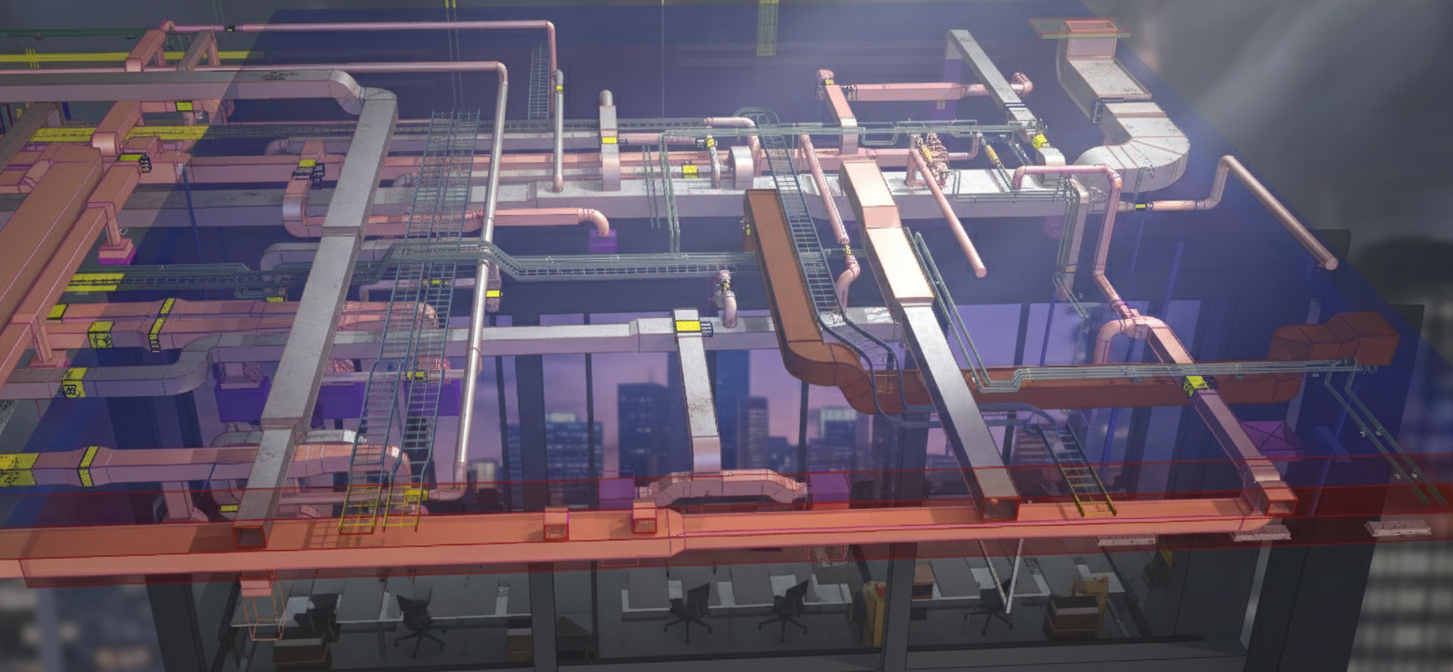
The elevation concept allows us stratified organisation of installations according to direction and function and makes it easier to add subsequent installation.
How does it work?
- Semi-transparent horizontal layers are placed within the model to define different height zones.
- Installations running east-west are grouped into one zone, and those running north-south into another
- This approach reduces the need for elbows, crossings, and additional supports.
And what is the result?
- A clean and well-structured model
- Easier and faster installation
- Lower costs and fewer complications on site
Practical Tips for Designers
Agree on a time
At the start of the project, coordinate openings in beams with the structural engineer.
This keeps the upper zones of the elevation concept functional and avoids later modifications.
Openings and Planning
If you’re unsure where to place openings, refer to industry recommendations or lessons learned from previous projects.
This greatly simplifies routing, especially for sprinkler networks and sloped piping.
Number and Height of Zones
Modelling two elevation zones is optimal.
For more complex projects, additional zones may be needed but avoid exceeding six zones, as it can cause confusion.
If space is available below the lowest zone, leave at least 1200 mm of clearance for access (800 mm minimum, also known as the “crawl zone”).
The recommended height of each zone is 400–600 mm, with up to 800 mm only in exceptional cases.
Always coordinate with ventilation designers, as duct dimensions directly impact zone heights.
Proper System Layering
Correct layering of systems facilitates coordination and reduces clashes. The recommended order is:
- Sprinklers – Placed in the highest elevation zone to ensure effective fire suppression.
- Electrical Systems – Routed above piping systems to prevent water from leaking onto cable trays.
- Piping – Positioned in the middle, branching downward as needed.
- Gas Systems – Installed in the lower zone, branching upward for safe and controlled routing.
- Sloped Piping – Ideally routed along building perimeters, where exceeding the allowable elevation is less disruptive. This preserves usable space and reduces the need for ceiling drops.
- In the early design phases, we strictly avoid any violations of height and spatial constraints. Later, once all disciplines are coordinated, minimal deviations may be allowed — but only at the ends of installation zones and along concrete walls.
- This approach preserves the functionality and safety of the structure while still facilitating the final coordination.
A Combination That Delivers Results
By applying this principle, we achieve:
- Safe and functional buildings
- Simplified maintenance
- Improved clarity during construction
- Faster and more precise coordination among all stakeholders
In BIM coordination this is not a luxury. It is a necessity for creating lasting, high-quality projects.
Plan Smart, Model Responsibly
The elevation concept might seem like a technical detail, but it directly impacts everyday building use.
When properly integrated into the BIM model, these “details” become the backbone of safety, efficiency, and long-term sustainability.
In our practice, focusing on these elements leads to fewer issues on-site, more satisfied users, and greater investor confidence.
BIM coordination isn’t just about clash detection, it’s about strategic, forward-thinking design.
If you missed the first two topics, we highly recommend reading them for a complete understanding of the process:
- BIM Coordination: Service Spaces and Access Routes – on the importance of planning space for installations and access.
- BIM Coordination: The Invisible Pillar of Successful Construction Projects – on coordination as a fundamental factor for success on the construction site.
