


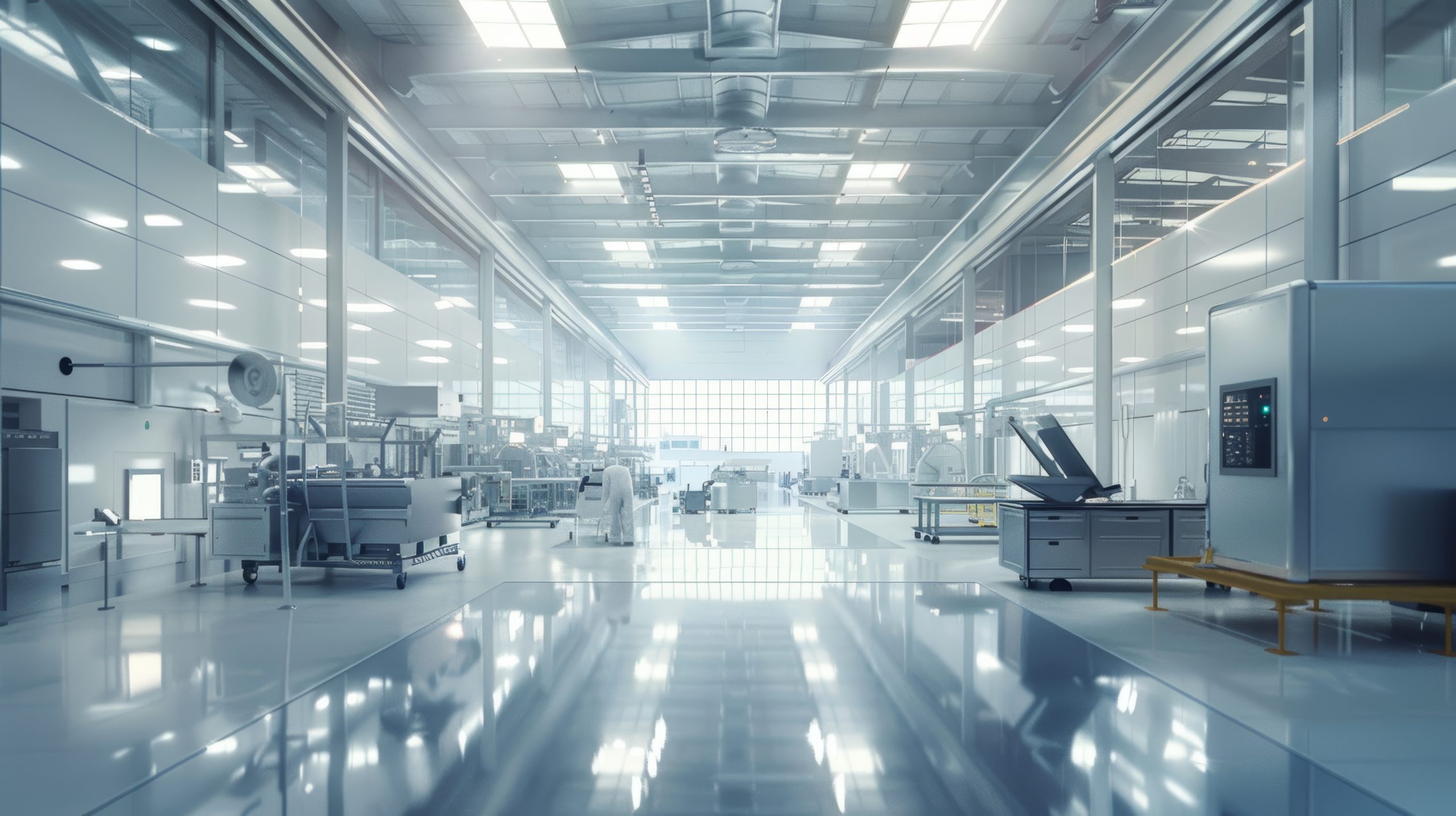
HVAC in the pharmaceutical industry
Why is HVAC in the pharmaceutical industry much more than heating and cooling?
In most commercial and industrial facilities, the HVAC system is designed primarily to ensure adequate temperature, air quality, and comfortable or technologically acceptable conditions for people’s stay. In the pharmaceutical industry, the starting point is completely different. .
HVAC in the pharmaceutical industry is not only a microclimatic factor, but one of the key elements of contamination control and maintenance of defined production processes.
Temperature and relative humidity are still important. However, at the same time, the designer must manage the particle concentration, the direction of airflow, differential pressures between rooms, advanced filtration, the number of air exchanges, and the risk of transferring contaminated particles between different zones.
The system must maintain all set parameters continuously, reliably and, most importantly, demonstrably.
The Role of HVAC in Contamination Control
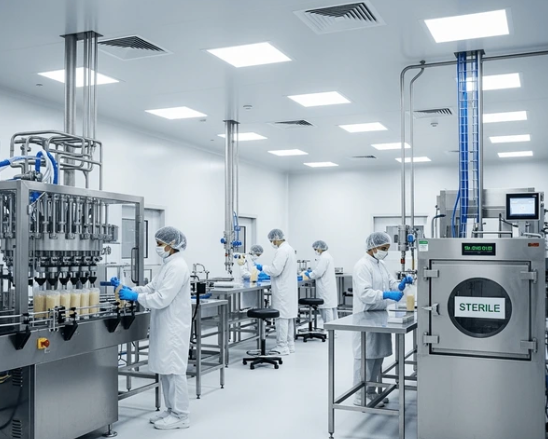
One of the first and fundamental differences from conventional buildings lies in the way air quality is observed. While conventional systems think about the level of carbon dioxide (CO₂) and comfort, in pharmaceutical production the main question is: what exactly is in the air and where can this air end up?
Contamination can come from people, processes, equipment, raw materials, or the ventilation system itself. Particles and microorganisms can irreversibly compromise a pharmaceutical product.
In some processes, such as working with potent substances, the product itself can cause a serious danger to operators and the surrounding area. That’s why design starts with a deep understanding of the process.
Key questions arise: Where is the product exposed to the surrounding space? What are the trajectories of operators and raw materials? Where is the greatest risk of particle formation?
The answers to these questions determine how ventilation adapts to process risks, not just to the architecture of the room.
The Role of Differential Pressure in Pharmaceutical HVAC Systems
Differential pressures between rooms are one of the most recognizable protective mechanisms of pharmaceutical HVAC. To ensure that air always flows from a cleaner to a less clean space, a carefully calculated cascade of pressures is established.
Nevertheless, the challenge lies in the fact that the pressure is not a static number. Filters get dirty over time, process equipment turns on their own extractors, and fans change the operating point. In addition, the permeability of building elements is rarely ideal.
That is why the entire cascade must be viewed holistically, with the obligatory application of electronic interlocks (interlock systems) on the doors, which strictly prevent their parallel opening and pressure violation in the zone.
When working with potent substances that must not penetrate the surrounding zones under any circumstances, strict negative pressure is applied. In such scenarios, the product protection requirement must be seamlessly aligned with the requirement for complete containment of hazardous substances within the isolated area.
Temperature and humidity as active process parameters
In the office space, a deviation of several degrees will only cause the disapproval of employees. In pharmacy, however, such deviations can impair the stability of substances, affect the physical properties of tablets or cause microbiological contamination.
The designer must anticipate the behavior of the system in a wide variety of regimes: when the number of people in the room changes, when the heat loads of the equipment fluctuate, or due to extreme outdoor weather conditions. Dehumidification is a particular challenge, which often requires strong subcooling and then reheating the air to a set temperature.
This creates enormous energy consumption, opening up an eternal engineering task: how to meet strict validated conditions without turning the plant into a wasteful energy consumer.
The myth of the HEPA filter and the importance of air distribution
It is a common misconception that by installing HEPA filters, we automatically get a clean room. A HEPA filter is extremely important, but only one component of a complex contamination control system.
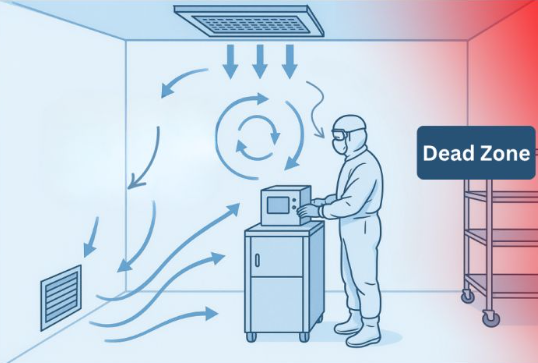
The end result depends on the overall distribution and airflow patterns. If so-called “dead zones”, short circuits between air supply and return, or unwanted turbulent vortices around critical equipment occur in the room, the nominal power and high efficiency of the filter lose their meaning. For this reason, cleanrooms are not designed simply by selecting filters, but by carefully planning the fluid dynamics and air behavior in the room.
GMP requirements and validation of pharmacy HVAC systems
The most important difference between conventional and pharmaceutical HVAC is the fact that the system must function within a strict GMP environment (eng. Good Manufacturing Practice). An engineering solution is not enough just to put it into operation. Its performance must be measurable, documentable and proven.
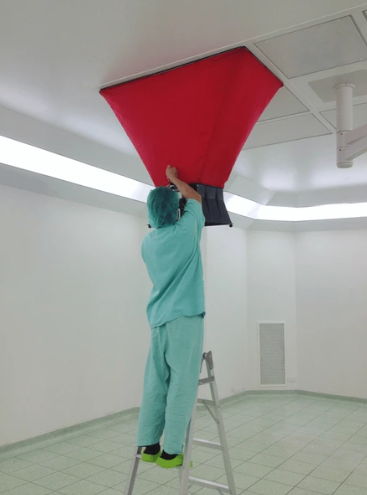
Already at an early stage of the project, it must be known how differential pressures will be measured and where temperature and humidity sensors will be placed. It is also necessary to define a way to check the integrity of HEPA filters and prove the correct airflow patterns. A quality project takes into account the process of subsequent testing, qualification and validation in advance.
A Holistic Engineering Approach to Pharmaceutical HVAC
Although pharmaceutical HVAC systems use seemingly familiar components—air handling units, fans, ductwork and control devices—the key difference lies in their ultimate purpose and the required level of reliability. Air becomes an active element in contamination control, pressure determines the direction of airflow and potential hazards, while automation and validation ensure regulatory compliance and technological integrity.
This is why Alfa Therm never approaches HVAC as an isolated technical system. By developing a thorough understanding of the process itself, the movement of people and materials, and the specific requirements for cleanliness and energy efficiency, we create comprehensive engineering solutions.
The best engineering solutions do not rely on unnecessary oversizing. Instead, they achieve a reliable, rational and verifiable balance between stringent pharmaceutical requirements and optimized energy consumption throughout the facility’s entire life cycle.
